
Jungian Typology According to Marie Louise Von Franz
An AI assisted diagram

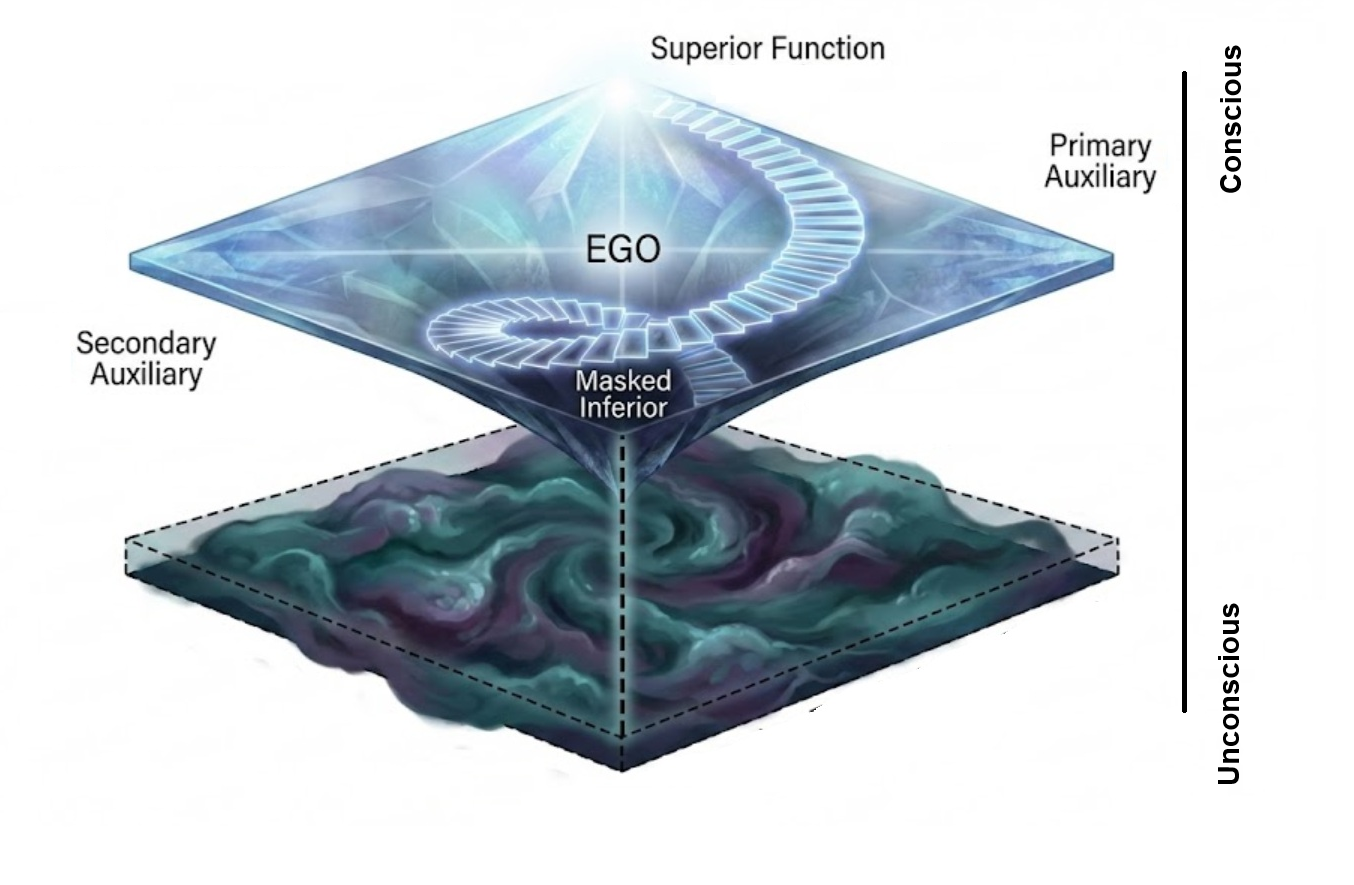
This diagram below is a topological interpretation of the Jungian psychological framework as elaborated by Marie-Louise von Franz*, modeling the structural tension between the Field of Consciousness and the Unconscious Totality.
At the top is depicted the Superior Function, which the ego utilizes as its primary, high-speed lens for identity and adaptation.
Development is visualized as a serpentine Path, suggested by the glowing spiral staircase, a circuitous movement through the Primary Auxiliary and the Secondary Auxiliary (the “Gatekeeper”) functions** to establish intermediary buffers before confronting the depths.
At the lowest point lies the Masked Inferior Function, often experienced by the ego as a “sore spot” or the “Greatest Cross.” This masked inferior is tethered to the deep unconscious (indicated by the dotted line). The right-hand sidebar shows the spectrum of consciousness, from the field of ego-differentiation to the fluid realm of the unconscious totality [Note: This diagram was synthesized through a sequence of iterative structural prompts based on readings of von Franz***, and rendered using Gemini’s "Banana" image generation engine].
I more recently came across this diagram from Jolande Jacobi’s introduction to Jungian Psychology (link).
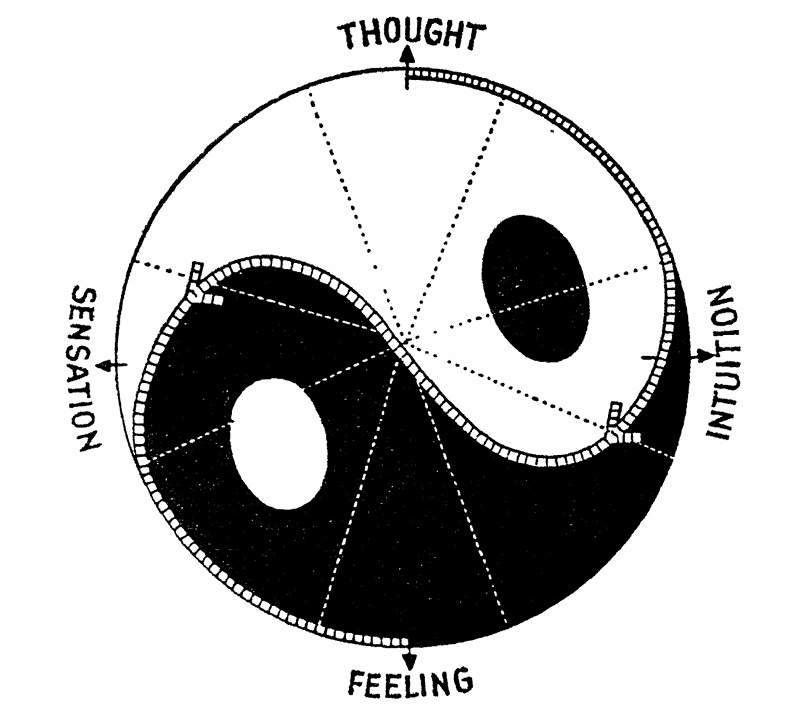
Here is Jacobi’s description of the figure.
“The course of the arrow, the path, does not take the form of a cross, as one might suppose, but goes from above to the right (whereby one might think of these two sectors of the bright region as representing symbolically father and son), then to the left where darkness already prevails (as symbol of the daughter), and lastly to the fourth function, lying altogether in the darkness of the mother's womb”
In this figure, Thought is the superior function, intuition the first auxiliary, sensation the second auxiliary, and feeling the inferior function.
Notes
*Von Franz, Marie-Louise, and James Hillman. Lectures on Jung’s Typology. Spring Publications, 1971 (available as of 12/18/2025 on Scribd).
**The four functions, “thinking”, “feeling”, “sensing” and “intuition”, must be understood in Jungian terms, not according to common sense usage, where they are often conflated with emotion, physical touch, or vague hunches. In the Jungian framework, Thinking is not merely the passive occurrence of thoughts, but a rational function of intellectual judgment that establishes conceptual relations (or order) and logical relations, clarifying “what” something is. Feeling is not emotional affect, but a rational function of evaluation that judges acceptance or rejection. Sensation is not merely receiving data, but the function that anchors the ego in the concrete “here and now” (reality). Intuition is not a “gut feeling,” but the precise perception of future possibilities and the “not yet visible”. Regarding these functions, five structural rules may be formulated based on the writings of Jung and von Franz. The first is the Axis Rule, which states that the superior and inferior functions are perpetually arranged as opposites; if a rational function is superior, its rational counterpart is inferior, and the same applies to the irrational axis. Second is the principle of Variability, which asserts that there is no inherent hierarchy among the functions, as any of the four can serve as the primary mode of adaptation depending on the individual. Third, the Differentiation Rule establishes the superior function as the ego's primary, high-speed tool for identity and the organization of the field of consciousness. In contrast, the fourth rule of Autonomy describes the inferior function as a slow, autonomous, and often tyrannical force charged with unadapted, "barbaric" emotion that happens to the ego rather than being directed by it. Fifth, the Limitation Rule (3+1) asserts that the four functions can never be simultaneously conscious; while the first three functions may be differentiated, the fourth must remain the "open door" to the unconscious, contaminated by the collective totality and resisting integration into the upper conscious layer. Caveats: One can become frustrated with the literature on the four functions, since it often lacks consistency and precision. The secondary tradition is particularly divergent: for example, Marie‑Louise von Franz, in her discussions of typology, refers to a first and a second auxiliary function, whereas Jolande Jacobi tends to speak of “the” auxiliary function in the singular. Jung himself shifts his account between the early formulations in Psychological Types and the later, more popular presentation in Man and His Symbols, so that no single, fully coherent model of the functions and their hierarchy is ever firmly established. Within orthodox Jungianism, it is generally maintained that there is no inherent hierarchy of value among the functions and that any of the four may serve as the primary mode of adaptation (so, for instance, intuition may be either superior or inferior). At the same time, Jung’s persistent association of introverted intuition with the unconscious creates the impression of a “natural” affinity between intuitive consciousness and unconscious material, which would seem to make intuition especially suited to the inferior position, even though this is explicitly denied at the level of official doctrine. This leaves, in my view, a genuine and unresolved tension within the Jungian typological framework.
***Marie-Louise Von Franz (1915–1998), sometimes referred to as “The Alchemist’s Daughter,” was a member of C. G. Jung’s inner circle and eventually became one of his primary intellectual collaborators, particularly regarding his extensive research into alchemy. A brilliant but introverted woman who lived for years with fellow analyst Barbara Hannah, von Franz was fiercely protective of Jung’s legacy, adhering strictly to his original concepts regarding the feminine and the animus in her own prolific writings on fairy tales and numerology. She remained close to Jung till the end of his life, privy to his final visions and trusted to complete Emma Jung’s unfinished work on the Grail legend (link). This information was taken from Maggy Anthony’s Jung’s Circle of Women: The Valkyries. Revised ed, 1999 (link).